Engagement intelligence for financial due diligence teams
Turn client uploads into source-backed diligence findings.
SynthGL helps QoE/FDD managers see the live engagement state. A request list, a no-login client upload portal, and an engagement dashboard that show what arrived, what changed, what ties out, and what still needs review before deliverables update, with every finding cited to the source cell.
Ingest
Every upload feeds the live engagement state
Managers see what changed, what is blocked, and what needs management follow-up.
Trust
Every answer traces to evidence
Findings point back to the request, document, sheet, and source cell.
Request list and client upload portal
Send a scoped link to the target company. The client uploads files without an account. Every file lands tied to a request-list item so the team knows what is done and what is still open.
Auto-classification with confidence
SynthGL reads each upload and classifies it against the request list with green, yellow, or red confidence. "AP aging, tied to request item 7" beats "some spreadsheet arrived."
Workbook integrity checks on ingest
Broken references, divide-by-zero, orphan sheets, and missing tabs surface the moment a file lands. The team catches model issues before the client call, not after.
Cited answers through approved AI tools
Ask "what did the client send for revenue support?" through the read-only SynthGL tool in Claude Desktop. SynthGL answers with the exact file, sheet, and cell. Read-only, scoped to the engagement.
How it works
From a client upload to a cited manager review.
A Quality of Earnings (QoE) engagement inside Financial Due Diligence (FDD) spans a month of trickle-in files, version collisions, tie-outs, and partner questions. SynthGL tracks the full arc so the team is not rebuilding the story from email every Monday.
The client uploads against the request list.
Send a scoped link to the target company. They upload through a portal that does not touch the firm's auth. Every file arrives tagged to a request item.
SynthGL classifies, checks, and routes.
Uploads are classified against the request list with green, yellow, or red confidence. Workbook integrity issues surface on ingest. The dashboard shows the 28 of 42 items still outstanding.
The manager gets cited answers and a clean handoff.
Ask from Claude Desktop through SynthGL's read-only tool: "what ties, what does not, what support is missing?" The answer comes back with the source file, sheet, and cell. The team reviews evidence, not tracking spreadsheets.
Why this holds up under partner review
Every number, classification, and status points back to a specific file and cell. Reviewers verify the work. They do not reconstruct the audit trail under deadline.
Inside the product
Know what arrived, what changed, and what still blocks the work.
Four surfaces the team uses every day.
Market evidence
21.3%
of broken 2025 LOIs in Axial's sample were attributed to QoE EBITDA discrepancies.
Axial's data gives the pilot a sharper reason to exist: EBITDA support has become a board-level diligence risk.
Axial's 2025 Dead Deal Report found QoE EBITDA discrepancies in 21.3% of its broken-LOI sample, up from 10.6% in 2023. SynthGL is built to move discrepancy review earlier in the intake flow, with cited evidence instead of late-stage reconstruction.
Read the sourced reportToday
Email + file share47 threads. 12 versions. 0 structure.
- NWC_v7_FINAL_use_this.xlsxEmailed Mar 14
- NWC v7 UPDATED.xlsxEmailed Mar 14
- NWC_v7_FINAL_v2.xlsxShared Mar 15
- EBITDA_bridge_CFO_v3.pdfEmailed Mar 16
- AR_aging_Feb_DO_NOT_USE.xlsxShared Mar 15
- TB_2024Q4_w_adj.xlsxEmailed Mar 18
With SynthGL
Request listOne list. One source. One status per file.
- REQ-014nwc_v7_final.xlsxNormalized
- REQ-015ebitda_bridge.pdfIn Review
- REQ-016ar_aging_feb.xlsxReceived
- REQ-017tb_2024q4.xlsxNormalized
- Every row traces back to a source cell
Left: 47 threads, 12 versions, 0 structure. Right: one list, one source, one status per file.
Client portal
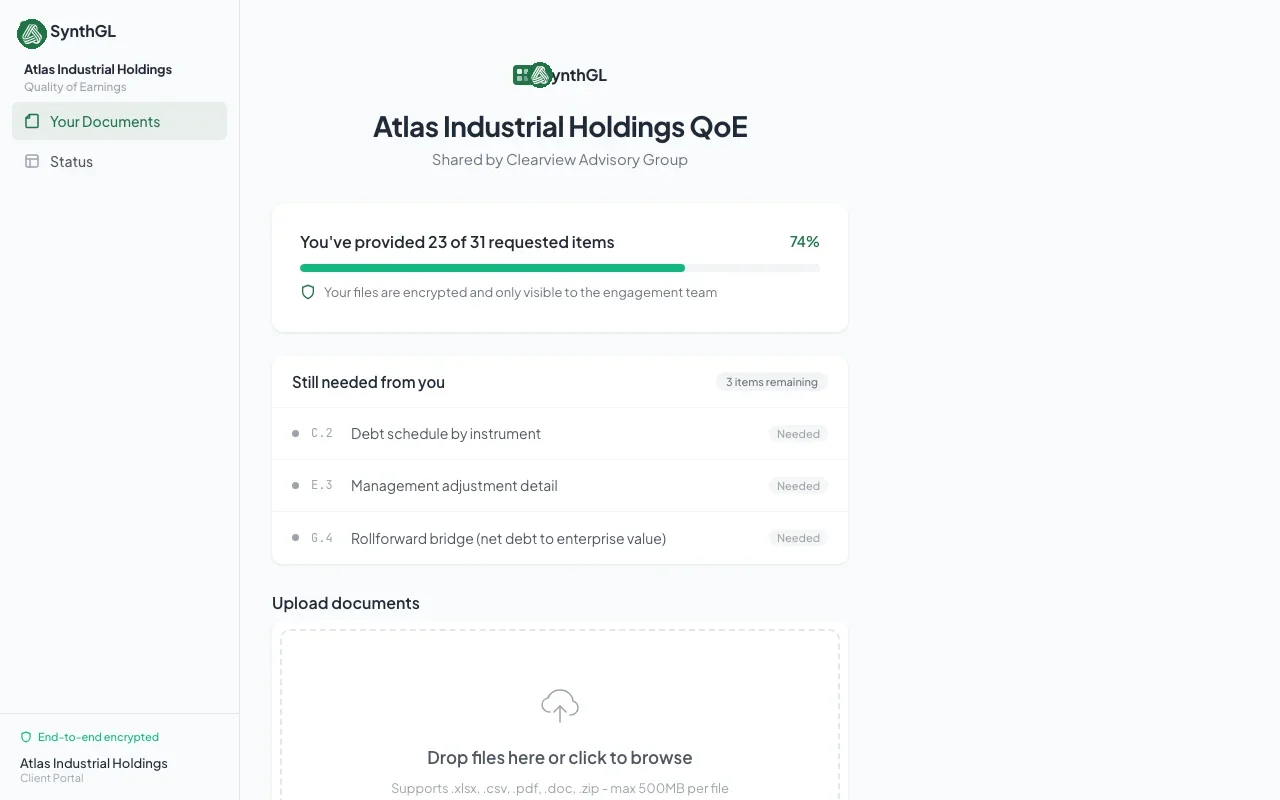 Status updates when the file landsFilename kept as the client sent itReview thread in the engagement
Every file arrives classified
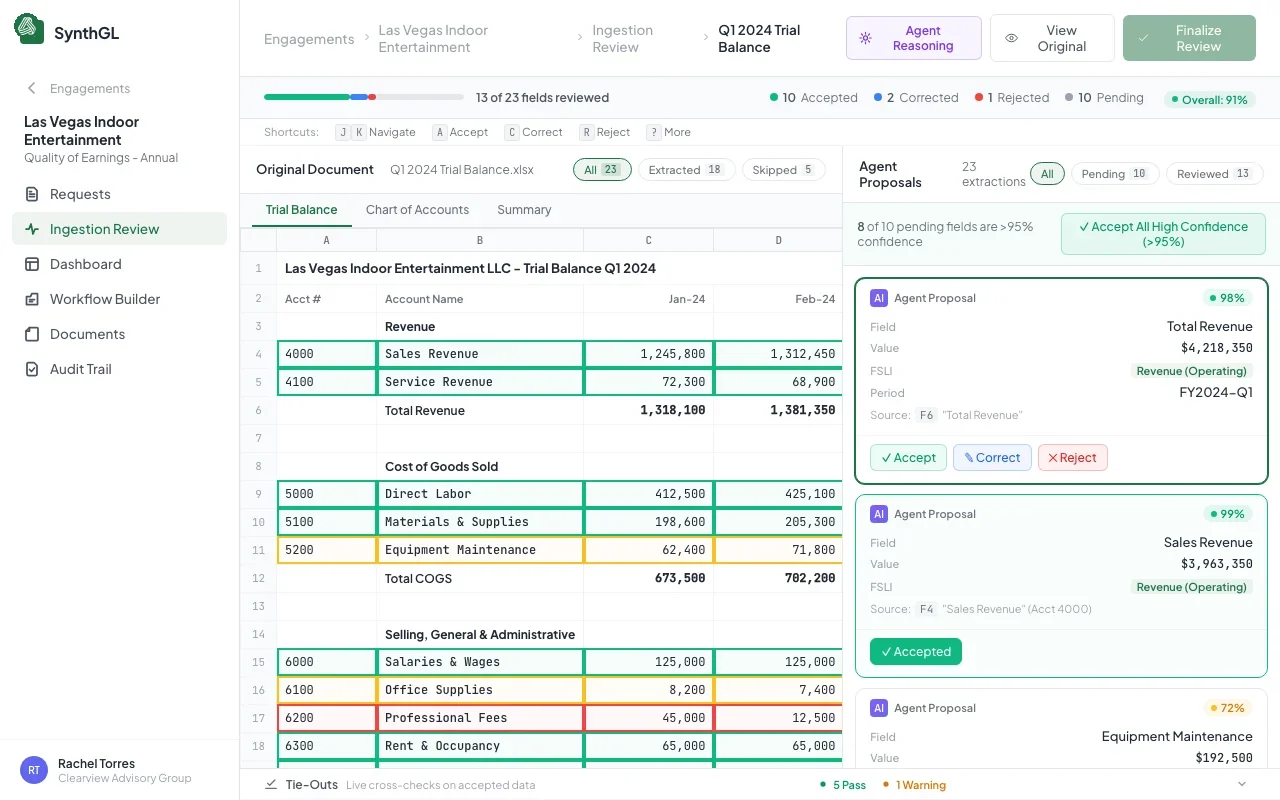 Confidence badge per fileTied to request itemIntegrity checks on ingest
One dashboard for the engagement
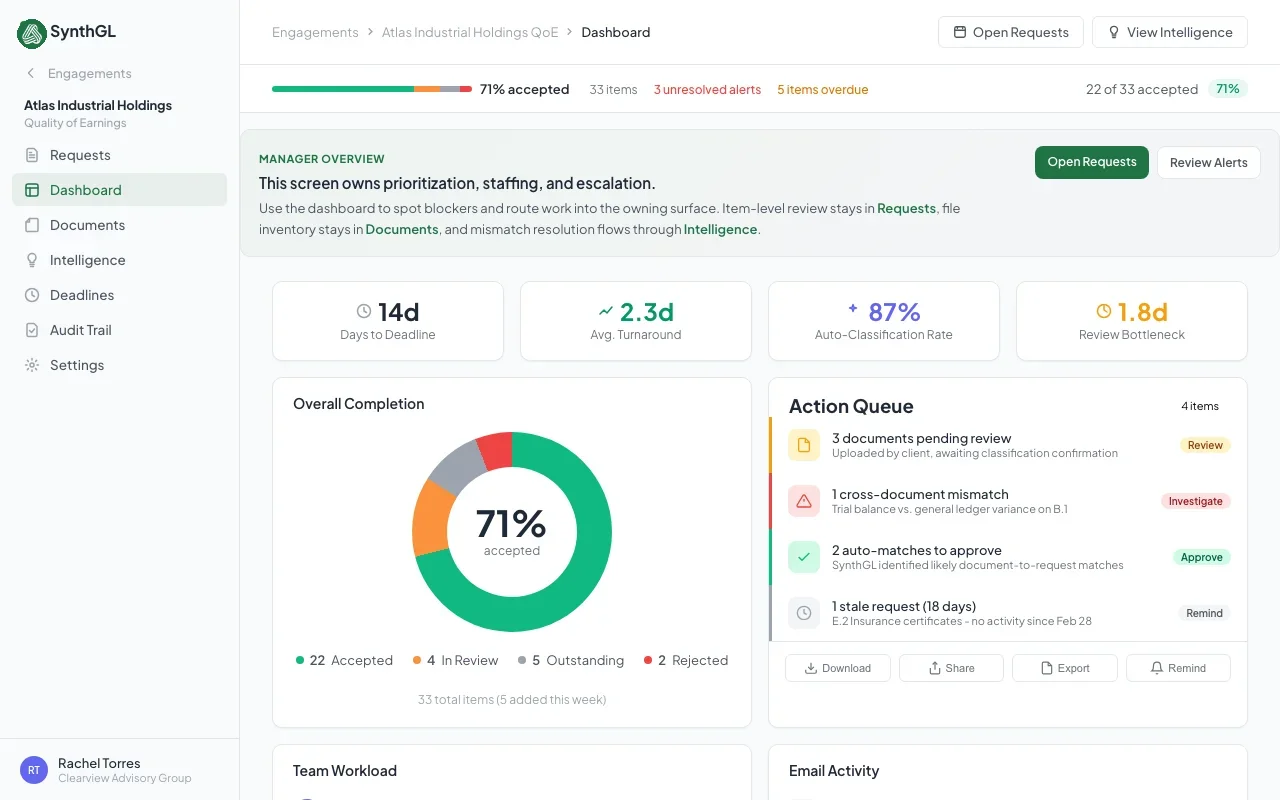 28 of 42 requests outstandingRevenue quality 78%1 unresolved finding
Trust
Three boundaries that hold before we write a line of data.
Pilot teams need to know what SynthGL will and will not do with client files before the first upload. These are the boundaries.
Read-only answer layer for AI assistants
When an analyst asks an approved AI assistant a question about the engagement, SynthGL returns cited answers. It does not accept writes back. Nothing outside SynthGL can modify the engagement record.
Scoped to the engagement, scoped to the firm
Every data room sits inside one firm and one engagement. A file uploaded to deal A never surfaces in deal B, and customer files are not used to train shared models.
Client portal is separate from firm auth
The target company uploads through a no-login link. They never see the firm's SSO, audit trail, or other client engagements. The separation is structural.
Read the full governance detail - subprocessor table, AI learning policy, retention specifics, and the seven procurement questions answered inline.
Under the hood
The reconciliation runs deterministically. Same inputs produce the same findings Monday morning and Friday afternoon.
Every typed fact in engagement memory carries a pointer back to its source file, sheet, and cell. Open the deliverable, click the finding, land on the exact evidence.
Where SynthGL fits
One side of the table, one shared workspace between two firms.
Quality of Earnings (QoE) work for Financial Due Diligence (FDD) teams, audit, 409A, fund admin, credit underwriting: any engagement where one firm reviews financial documents produced by another firm. Built around the deliverables financial due diligence teams already run: Adjusted EBITDA, net working capital analysis, proof of cash, debt and debt-like items. We do not replace the databook. We make what feeds it trustworthy.
vs Suralink
Suralink answers "did we get the file?" SynthGL answers "what does the file tell us?" The request list lives in both. Only SynthGL reads the contents.
vs DataSnipper
DataSnipper is per-document manual validation inside Excel. SynthGL runs engagement-wide reconciliation across every file the client has sent.
vs company-side finance tools (Basis, Campfire, Rillet, FloQast)
Those tools help a company close its own books. SynthGL helps firms review the books another company sent them. Different side of the table.
vs Claude Enterprise
Claude helps an analyst inside one firm. SynthGL is the shared workspace between two firms. An approved AI assistant, such as Claude Desktop, can query SynthGL read-only to answer engagement questions with citations.
Frequently asked
What pilot teams ask before they upload the first file.
Six questions managers, partners, and reviewers bring to the first call.
How do you handle confidential client documents?
Tenant-scoped engagements with row-level security per deal. Client files support the engagement they were uploaded for and only that engagement. Never used to train shared models.
Pilot program
Run one engagement on SynthGL alongside your current workflow.
One active or recent Quality of Earnings (QoE) engagement for a Financial Due Diligence (FDD) team, four weeks, weekly check-in. We are selecting a small group of financial due diligence teams that run Quality of Earnings work.
Best fit for the first pilots
Financial Due Diligence managers running Quality of Earnings engagements. You own the engagement arc end-to-end and feel the drag of intake, re-briefing, and evidence review on every deal.
What you get
- Engagement, data room, and memory configured for your workflow
- Read-only AI assistant connection for cited answers
- Onboarding with the founder, direct feedback loop
- Priority on the features your team needs first
What we ask
- One active or recent Quality of Earnings engagement
- A 30-minute weekly check-in
- Honest feedback on what works and what does not
- Optional quote or case study if the result is worth sharing
After you apply
We review fit and follow up within two business days. If there is a match, we schedule a working session to scope the engagement and set up your data room.
Tell us about your engagement.
Share the engagement type, your current workflow, and where the intake and review steps slow the team down. That context shapes the first call.